Robotic Process Automation and 3D Printing
Automation has progressed beyond physical factory robots into the digital workspace. Two game-changing technologies covered in the NIELIT CCC curriculum are Robotic Process Automation (RPA) and 3D Printing (Additive Manufacturing). In Hindi, hum ise kehte hain "Daftari kamon ka software bot dwara automatic hona (RPA) aur 3D vastuon ka nirmaan (3D Printing)".
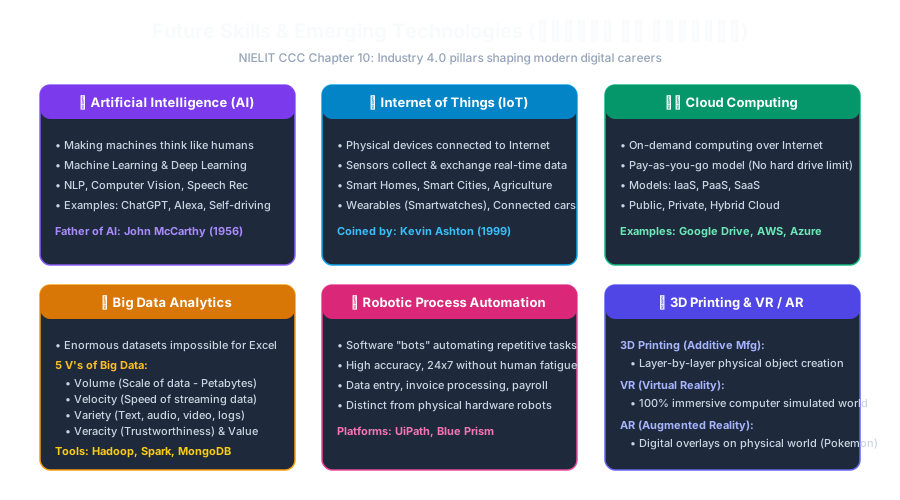 Click to Zoom
1. Robotic Process Automation (RPA)
Many people confuse RPA with physical metal humanoid robots like those in car factories. In reality, RPA uses Software Bots (chote computer programs) that mimic repetitive actions performed by a human worker on a computer screen.
What is RPA?
Robotic Process Automation is the application of software with artificial intelligence and machine learning capabilities to handle high-volume, repeatable tasks that previously required human beings to perform.
- Analogy: Imagine a clerk who opens an email every morning, downloads an attached Excel invoice, copies the invoice number and amount, and pastes it into an accounting software like Tally. An RPA bot can perform this exact sequence of 1,000 invoices in minutes without human fatigue or typing errors!
Ideal Candidates for RPA Automation:
- Rule-based, repetitive computer workflows.
- High-volume data entry and data reconciliation.
- Reading PDF invoices and populating database tables.
- Employee onboarding and payroll processing.
Industry Leaders in RPA Software:
- UiPath: One of the world's most widely used enterprise automation platforms.
- Blue Prism: Pioneer in enterprise robotic software.
- Automation Anywhere: Widely deployed cloud automation platform.
| Human Worker | RPA Software Bot |
|---|---|
| Works 8 hours a day, needs breaks and sleep. | Runs 24x7x365 continuously without stopping. |
| Prone to accidental copy-paste typing errors when tired. | Delivers 100% rule-based accuracy and consistency. |
| High repetitive fatigue and boredom. | Handles millions of routine clerical transactions effortlessly. |
2. 3D Printing (Additive Manufacturing)
Traditional manufacturing (like carving a statue from marble or cutting gears on a lathe machine) is Subtractive Manufacturing—starting with a large block of material and cutting away excess waste.
In contrast, 3D Printing is Additive Manufacturing—building a three-dimensional physical object by depositing material layer by layer directly from a digital 3D computer file.
How 3D Printing Works (The 3-Step Process):
- 1Design a 3D Model: The designer creates a digital model using CAD (Computer-Aided Design) software or 3D scanners (saved typically in
.STLor.OBJformat). - 2Slicing the Model: Specialized "Slicer software" cuts the 3D model into thousands of paper-thin horizontal 2D cross-section layers and generates machine G-code instructions.
- 3Layer-by-Layer Printing: The 3D printer extrudes melted plastic filament (PLA / ABS), resin, ceramic powder, or metal layer-by-layer until the solid 3D object is fully formed.
Real-World Applications of 3D Printing:
- Healthcare & Dentistry: Customized dental aligners, prosthetic artificial limbs shaped to a patient's exact anatomy, hearing aids.
- Construction & Housing: 3D concrete printers constructing complete single-story houses in just a few days at low cost.
- Aerospace & Automotive: Lightweight, complex rocket engine nozzles and airplane brackets manufactured in titanium with zero metal waste.
- Education & Prototyping: Rapid prototyping of engineering project models in schools and polytechnic institutes.
Multiple Choice Questions
1. What does 'RPA' stand for in modern enterprise office automation?
A. Real Protocol Access B. Robotic Process Automation C. Remote Program Allocation D. Random Pixel Alignment Answer: B Explanation: RPA stands for Robotic Process Automation, which refers to software robots that automate routine, rules-based computer tasks.
2. Unlike traditional subtractive manufacturing, how does 3D printing manufacture physical objects?
A. By heating iron in a furnace B. By cutting away stone with a chisel C. By adding material layer upon layer (Additive Manufacturing) D. By spinning thread on a loom Answer: C Explanation: 3D printing is an additive manufacturing process that creates physical objects by successively depositing material layer upon layer from a digital 3D model.
3. Which of the following is an example of an enterprise software platform used to build RPA bots?
A. UiPath B. Adobe Reader C. VLC Media Player D. LibreOffice Impress Answer: A Explanation: UiPath, along with Automation Anywhere and Blue Prism, is an industry-leading software platform used for developing Robotic Process Automation bots.
4. Which file format is universally used to export 3D digital models for 3D printer slicing software?
A. .mp3 B. .stl C. .docx D. .xlsx Answer: B Explanation: .STL (Standard Tessellation Language / Stereolithography) is the standard file format used for transferring 3D CAD models to 3D printer slicing software.
5. Which of the following workplace tasks is BEST suited for automation using an RPA bot?
A. Writing a creative poem for an advertisement B. Manually copying 500 invoices every day from email attachments into an accounting system C. Conducting a personal job interview with a candidate D. Resolving an emotional conflict between coworkers Answer: B Explanation: RPA bots excel at repetitive, high-volume, rules-based tasks like copy-pasting structured invoice data into accounting software.
Future Trends in ICT and AI-driven Innovation
Continue learning with hands-on practice, examples, and exercises in the upcoming topic.
Related Lessons
| Previous Lesson | Next Lesson |
|---|---|
| Applications of AI in Daily Life | Future Trends in ICT and AI-driven Innovation |
Practice Quiz
Test your understanding of this lesson with 5 questions. Each question has one correct answer.