Introduction to Future Technologies
We are living in the era of the Fourth Industrial Revolution (Industry 4.0), where computing power, artificial intelligence, hyper-connectivity, and physical machinery are blending into smart, automated ecosystems. In Hindi, hum ise kehte hain "Bhavishya ki nai takneekein aur digital kramik vikas".
Chapter 10 of the NIELIT CCC curriculum equips students with a foundational understanding of these cutting-edge technologies that are reshaping employment, governance, manufacturing, and society.
 Click to Zoom
1. The Four Industrial Revolutions (A Historical Journey)
To understand where technology is headed, let us look at the evolution of modern industry:
| Revolution | Time Period | Defining Technology | Impact on Society |
|---|---|---|---|
| Industry 1.0 | Late 18th Century (1780s) | Steam Engine & Mechanical Power | Mechanized textile production, railways. |
| Industry 2.0 | Late 19th Century (1870s) | Electricity & Assembly Line Production | Mass factory manufacturing (Henry Ford). |
| Industry 3.0 | Mid 20th Century (1970s) | Computers, Transistors & Automation | IT revolution, PCs, internet, robotics. |
| Industry 4.0 | Present Day (2010s-Future) | Cyber-Physical Systems, AI, IoT, Cloud | Autonomous factories, smart cities, self-learning machines. |
 Click to Zoom
2. Core Pillars of Future Skills (Industry 4.0)
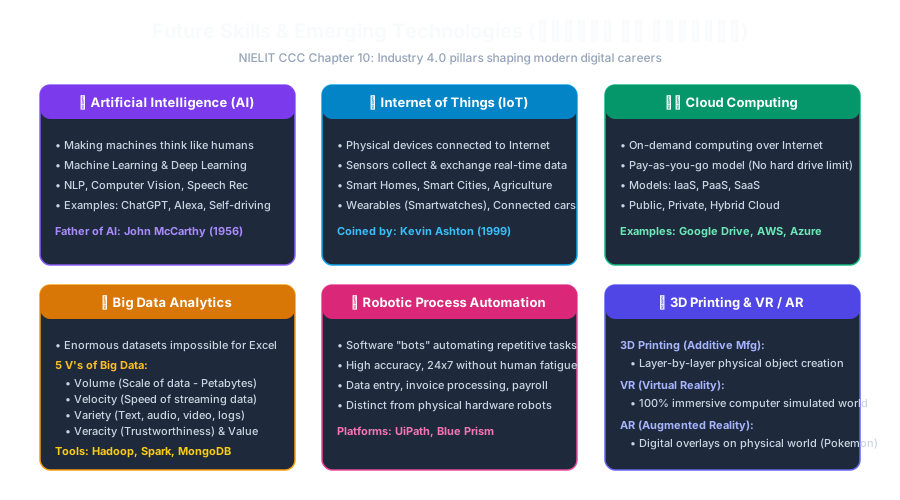
The NIELIT syllabus highlights several transformative domains:
- 1Artificial Intelligence (AI) & Machine Learning (ML):
- Enabling computer systems to perform tasks that traditionally require human intelligence—such as visual perception, natural language translation, speech recognition, and decision making.
- 1Internet of Things (IoT):
- A worldwide network of interconnected physical devices (smart bulbs, ACs, cars, agricultural soil sensors) embedded with electronics, sensors, and network connectivity to exchange data in real time.
- 1Cloud Computing:
- On-demand delivery of IT resources (servers, database storage, processing power, and software) over the internet on a pay-as-you-go pricing model.
- 1Big Data Analytics:
- Analyzing massive, high-velocity datasets that cannot be handled by traditional database tools, uncovering hidden patterns, customer preferences, and predictive insights.
- 1Robotic Process Automation (RPA):
- Using software "bots" to automate high-volume, rules-based repetitive computer tasks (like data entry, invoice extraction, and payroll generation).
- 13D Printing (Additive Manufacturing):
- Creating solid three-dimensional physical objects layer-by-layer directly from a digital 3D computer model.
- 1Virtual Reality (VR) & Augmented Reality (AR):
- Creating immersive simulated 3D environments (VR) or overlaying digital elements on the physical real world (AR).
3. Why Future Skills Matter for CCC Students?
- High Employability: Routine data-entry jobs are rapidly shifting toward automated workflows; learning these concepts helps youth prepare for technical roles.
- National Initiatives: Programs like Digital India, FutureSkills Prime (NASSCOM & MeitY), and Skill India provide nationwide certifications in these emerging tech areas.
- Problem Solving: Applying IoT in Indian agriculture (smart drip irrigation), AI in telemedicine for rural clinics, and Cloud storage for government records (Digilocker).
Multiple Choice Questions
1. Which term describes the current era of smart automation, cyber-physical systems, and AI-driven industries?
A. Industry 1.0 B. Industry 2.0 C. Industry 3.0 D. Industry 4.0 Answer: D Explanation: Industry 4.0 refers to the fourth industrial revolution characterized by smart automation, IoT, cloud computing, cognitive AI, and cyber-physical systems.
2. Which technology allows on-demand access to servers, storage, and software over the internet without owning physical servers?
A. Dial-up Networking B. Cloud Computing C. Local Area Network D. Floppy Disk Storage Answer: B Explanation: Cloud computing provides on-demand IT resources (storage, databases, computing power) over the internet with pay-as-you-go pricing.
3. What is the process of creating three-dimensional physical objects layer-by-layer from a digital model called?
A. Offset Printing B. Additive Manufacturing (3D Printing) C. Dot Matrix Printing D. Thermal Lamination Answer: B Explanation: 3D printing, also known as additive manufacturing, builds solid physical objects layer-by-layer based on computer-aided 3D designs (CAD).
4. Which initiative launched by MeitY and NASSCOM focuses on reskilling Indian professionals in future technologies?
A. FutureSkills Prime B. Kisan Credit Card C. PM Jan Dhan Yojana D. Sukanya Samriddhi Answer: A Explanation: FutureSkills Prime is a joint skilling initiative by MeitY (Ministry of Electronics and IT) and NASSCOM to train citizens in emerging technologies.
5. In which industrial revolution were steam power and mechanical looms first introduced?
A. Industry 1.0 B. Industry 2.0 C. Industry 3.0 D. Industry 4.0 Answer: A Explanation: Industry 1.0 began in the late 18th century with the introduction of steam engine power and mechanical manufacturing equipment.
Internet of Things (IoT) and Big Data Analytics
Continue learning with hands-on practice, examples, and exercises in the upcoming topic.
Related Lessons
| Previous Lesson | Next Lesson |
|---|---|
| Recognizing Online Fraud and Phishing | Internet of Things (IoT) and Big Data Analytics |
Practice Quiz
Test your understanding of this lesson with 5 questions. Each question has one correct answer.