Logical Functions (IF, AND, OR, NOT)
Logical Functions (IF, AND, OR, NOT)
Logical functions form the decision-making engine of your spreadsheets. By combining the fundamental IF statement with AND, OR, and NOT, you can create intelligent business models that evaluate complex multi-tier criteria automatically.
1. The Core IF Function
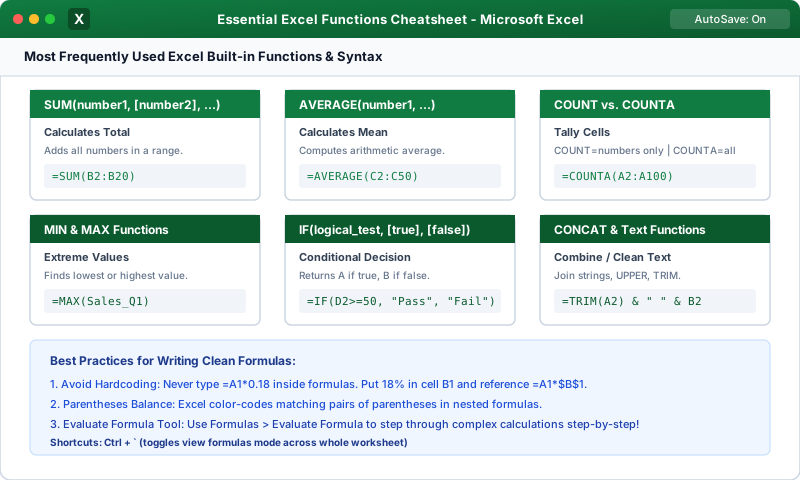
The IF function tests a logical condition and returns one value if the condition is TRUE, and another value if it is FALSE:
Basic Business Examples:
- Passing Grade: '=IF(C2 >= 40, "Pass", "Fail")'
- Sales Commission: '=IF(D2 > 100000, D2 * 0.05, 0)'
- Stock Alert: '=IF(E2 <= 10, "Reorder Now", "In Stock")'
 Click to Zoom
2. Expanding Conditions with AND & OR
A single IF statement tests only one condition. By nesting AND or OR inside the 'logical_test' argument, you can evaluate multiple columns simultaneously:
A. The AND Function (All Conditions Must Be Met)
Returns TRUE only if every single argument evaluates to TRUE:
If an employee has $60,000 in sales but a Rating of 3, AND returns FALSE and no bonus is granted.
B. The OR Function (At Least One Condition Must Be Met)
Returns TRUE if any one of the conditions evaluates to TRUE:
If a customer has a Gold membership, they receive free shipping even if their cart total is only $10.
3. The NOT Function (Inverting Logic)
The NOT function flips boolean truth values:
- '=NOT(TRUE)' returns FALSE
- '=NOT(FALSE)' returns TRUE
- Example: Check if customer is non-international:
4. Nested IF Statements
When evaluating multiple performance tiers (such as letter grades or discount brackets), you can place another IF statement inside the 'value_if_false' parameter:
Note: Always order your comparisons systematically (either highest to lowest, or lowest to highest) so thresholds trigger in the correct sequence.
Multiple Choice Questions
1. In '=IF(Score >= 50, "Pass", "Fail")', what is returned if Score is exactly 50?
A. Fail B. Pass C. #VALUE! D. TRUE Answer: B Explanation: The condition '>= 50' means greater than OR equal to 50. Since 50 equals 50, the condition is TRUE, returning 'Pass'.
2. Which function returns TRUE only if ALL tested conditions are satisfied?
A. OR B. AND C. NOT D. XOR Answer: B Explanation: The AND function requires all individual logical arguments to evaluate to TRUE in order to return TRUE.
3. What will '=OR(5 > 10, 8 = 8, 3 < 1)' evaluate to?
A. FALSE B. TRUE C. #N/A D. 8 Answer: B Explanation: Even though '5 > 10' and '3 < 1' are FALSE, '8 = 8' is TRUE. Because OR requires only one TRUE condition, the whole function evaluates to TRUE.
4. What will '=NOT(10 > 5)' return?
A. TRUE B. FALSE C. 10 D. 5 Answer: B Explanation: 10 > 5 is TRUE. Wrapping it in NOT(TRUE) inverts the result to FALSE.
5. If an employee must achieve Sales > 100,000 AND Experience > 3 years to qualify for Manager, which formula correctly tests eligibility?
A. =IF(OR(Sales>100000, Exp>3), "Manager", "Staff") B. =IF(AND(Sales>100000, Exp>3), "Manager", "Staff") C. =IF(Sales+Exp>100003, "Manager", "Staff") D. =IF(NOT(Sales>100000), "Manager", "Staff") Answer: B Explanation: Combining IF with AND ensures both conditions (Sales > 100,000 and Exp > 3) must be simultaneously TRUE to earn the "Manager" outcome.
VLOOKUP Basics (Exact Match & Syntax)
Continue learning with hands-on practice, examples, and exercises in the upcoming topic.
Related Lessons
| Previous Lesson | Next Lesson |
|---|---|
| Date & Time Functions (TODAY, NOW, DATEDIF, NETWORKDAYS) | VLOOKUP Basics (Exact Match & Syntax) |
Practice Quiz
Test your understanding of this lesson with 5 questions. Each question has one correct answer.