Text Emphasis: Bold, Italic, Strikethrough & Highlights
Emphasis styling allows you to highlight key terms, indicate deletions, or call attention to critical instructions. Markdown provides clean symbols that map directly to semantic HTML formatting tags.
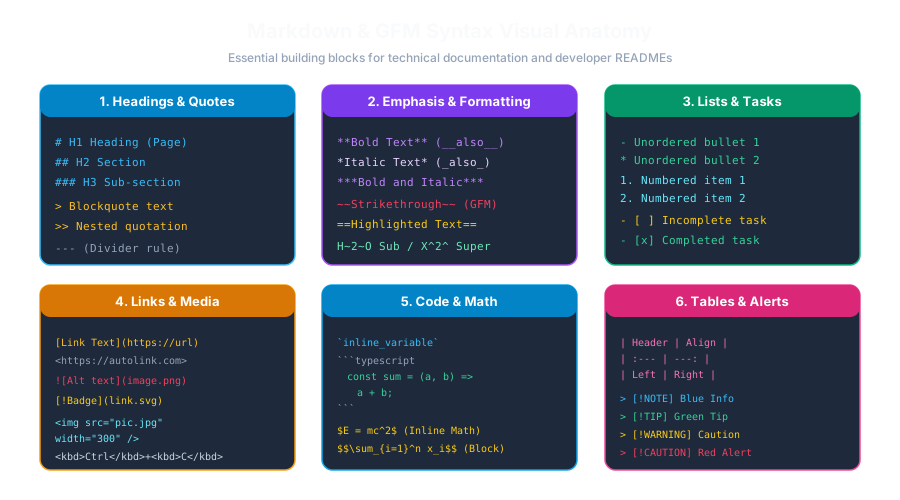 Click to Zoom
1. Bold Text (Strong Emphasis / <strong>)
To make text bold, surround it with two asterisks (`)** or **two underscores (__`)**:
- HTML Output:
<strong>very important</strong> - Best Practice: Prefer double asterisks (
**) because underscores inside words (likeuser_profile_name) can occasionally cause ambiguity in some parsers.
2. Italic Text (Emphasis / <em>)
To italicize text, surround it with a *single asterisk (`)** or **single underscore (_`)**:
- HTML Output:
<em>italicized</em>
3. Combining Bold and Italic (Bold-Italic)
To make text simultaneously bold and italic, surround it with three asterisks (``)*:
- HTML Output:
<strong><em>critically important and emphasized</em></strong>
4. Strikethrough (GFM Extension / <del>)
In GitHub Flavored Markdown, surround text with double tildes (~~) to show crossed-out or deprecated content:
- Rendered Output: <del>Deprecated: Use API v1</del>
- HTML Output:
<del>Deprecated: Use API v1</del>
5. Highlights, Subscripts & Superscripts (Extended Markdown)
In extended flavors like Markdown Extra, Obsidian, and Pandoc:
| Style | Syntax | Example | Use Case |
|---|---|---|---|
| Highlight | ==text== | ==Crucial concept== | Study notes & revision |
| Subscript | ~text~ | H~2~O | Chemical formulas ($H_2O$) |
| Superscript | ^text^ | X^2^ + Y^2^ | Math exponents ($X^2$) |
Multiple Choice Questions
1. What syntax is used to create bold text in standard Markdown?
A. bold B. bold C. ~bold~ D. #bold# Answer: B Explanation: Surrounding text with double asterisks (e.g. bold) renders bold text corresponding to the HTML <strong> element.
2. Which HTML element is typically generated when you apply single asterisks (italic) in Markdown?
A. <b> B. <em> C. <mark> D. <small> Answer: B Explanation: Single asterisks map semantically to the HTML <em> (emphasis) element.
3. How do you apply both bold and italic formatting simultaneously to a word?
A. Surround with three asterisks (*word) B. Surround with four hashes (####word####) C. Use brackets ([word]) D. Repeat the word twice Answer: A Explanation:* Three asterisks combine bold (2) and italic (1) to generate <strong><em>word</em></strong>.
4. What is the GFM syntax for strikethrough text?
A. --text-- B. text C. text D. __text__ Answer: B Explanation: Double tildes (text) are used in GitHub Flavored Markdown to render strikethrough text.
5. Why is 'bold' generally preferred over '__bold__' by technical writers?
A. Asterisks render in red color B. Underscores can clash with variable names containing underscores (such as snake_case_variables) C. Asterisks compile 10 times faster D. Underscores are not allowed on the internet Answer: B Explanation: Using asterisks prevents parsing conflicts when dealing with snake_case programming identifiers and file paths.
Blockquotes, Nested Quotes & Callouts
Continue learning with hands-on practice, examples, and exercises in the upcoming topic.
Related Lessons
| Previous Lesson | Next Lesson |
|---|---|
| Paragraphs, Line Breaks & Horizontal Rules | Blockquotes, Nested Quotes & Callouts |
Practice Quiz
Test your understanding of this lesson with 5 questions. Each question has one correct answer.