Introduction to Markdown & Philosophy
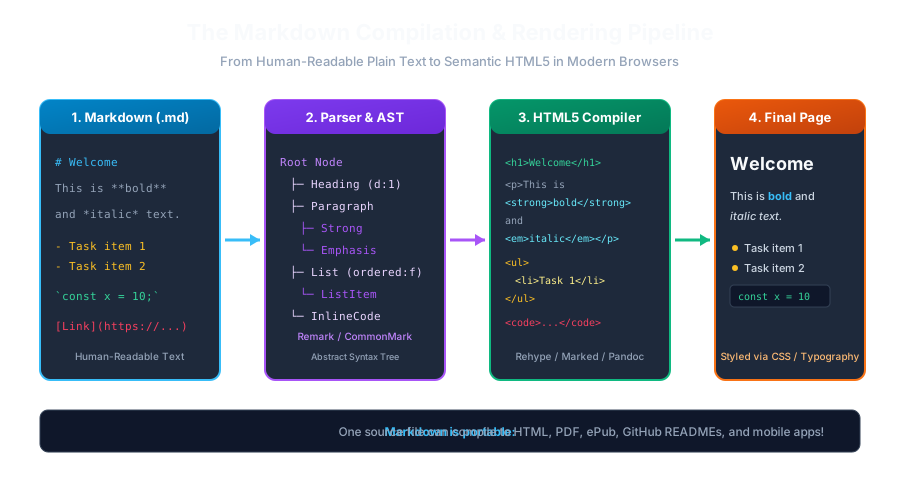
In the modern software industry, nearly all developer documentation, GitHub project descriptions, technical blogs, and team wikis are written in Markdown. Whether you are drafting a README.md for an open-source library or taking notes in Obsidian, Markdown is the universal standard for formatting plain text into clean, structured documents.
 Click to Zoom
1. What is Markdown?
Markdown is a lightweight markup language created in 2004 by John Gruber in collaboration with Aaron Swartz. It allows writers and programmers to format text using a clean, human-readable plain-text syntax that can easily be converted into semantically valid HTML5, PDF, or eBook formats.
- File Extension: Markdown files typically use the
.mdor.markdownextension. - MIME Type:
text/markdown(standardized in RFC 7763).
2. The Core Philosophy of Markdown
The defining principle behind Markdown is readability:
Compare how a heading and bold text look in HTML versus Markdown:
| Raw HTML (Cluttered) | Raw Markdown (Readable Plain Text) |
|---|---|
<h1>Getting Started</h1> | # Getting Started |
<p>Please <strong>read</strong> this.</p> | Please **read** this. |
<a href="https://example.com">Visit</a> | [Visit](https://example.com) |
Even if you open a Markdown file in a simple command-line editor like nano or notepad, the document is completely natural to read without mental translation of closing tags.
3. How Markdown Works (The Compilation Pipeline)
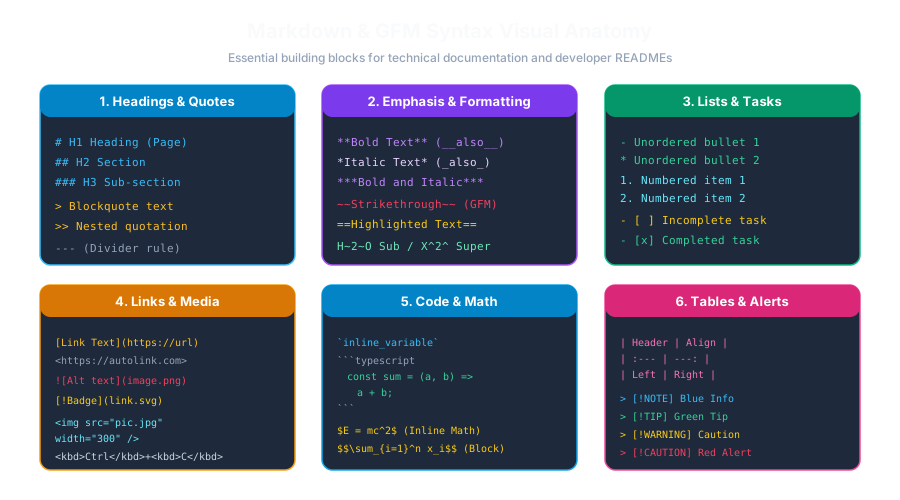
Markdown is not compiled by the browser directly; rather, it passes through a parsing pipeline:
- 1Source Text (
.md): The author writes plain text with lightweight symbols (#,*,-,>). - 2Lexer & Parser: A Markdown parser (like Remark, Marked, or CommonMark) parses the characters into an Abstract Syntax Tree (AST).
- 3HTML Generator: The AST is transformed into clean, standards-compliant HTML elements (
<h1>,<p>,<ul>,<code>). - 4Browser Rendering: The browser renders the HTML and applies CSS styles to produce a beautiful, responsive layout.
 Click to Zoom
4. Where is Markdown Used in Real-World Tech?
- GitHub & GitLab: Every repository's homepage is driven by
README.md. Issues, pull requests, and wiki pages all use Markdown. - Modern Static Site Generators: Tools like Next.js Contentlayer, Astro, Docusaurus, and MkDocs render complete documentation websites from markdown files.
- Note-taking & Knowledge Bases: Popular apps like Obsidian, Notion, Logseq, and Joplin use Markdown for future-proof, vendor-lock-in-free personal knowledge management.
- Chat & Team Tools: Slack, Discord, Microsoft Teams, and ChatGPT responses all interpret markdown syntax for formatting messages.
Multiple Choice Questions
1. Who created Markdown in 2004 alongside Aaron Swartz?
A. Tim Berners-Lee B. John Gruber C. Brendan Eich D. Linus Torvalds Answer: B Explanation: John Gruber created Markdown in 2004 with contributions from Aaron Swartz, aiming to build an easy-to-read, easy-to-write plain text formatting syntax.
2. What is the standard file extension used for Markdown documents?
A. .mk B. .txt C. .md D. .mdownx Answer: C Explanation: While .markdown is sometimes used, .md is the universally recognized and most widely adopted file extension for Markdown files.
3. What is the primary design philosophy behind Markdown syntax?
A. To execute code in the browser directly B. To be readable as-is in plain text without looking like code or markup tags C. To replace SQL database queries D. To compress image files on servers Answer: B Explanation: Markdown was designed so that the raw source text is pleasant and intuitive to read without visual distraction from tags.
4. How does a web browser display a Markdown file to the end user?
A. The browser native engine runs Markdown directly without translation B. A parser converts Markdown source into an Abstract Syntax Tree (AST) and compiles it into HTML C. The browser converts Markdown to binary machine code D. Markdown is printed onto paper first Answer: B Explanation: Browsers only understand HTML, CSS, and JavaScript; hence, a Markdown parser compiles the text into HTML elements that the browser then renders.
5. Which of the following software platforms uses Markdown for repository documentation and pull requests?
A. Adobe Premiere Pro B. GitHub C. Microsoft Excel D. AutoCAD Answer: B Explanation: GitHub relies fundamentally on Markdown for README files, issue discussions, pull requests, and project documentation.
Markdown Flavors & Specifications (CommonMark vs GFM)
Continue learning with hands-on practice, examples, and exercises in the upcoming topic.
Related Lessons
| Previous Lesson | Next Lesson |
|---|---|
| None | Markdown Flavors & Specifications (CommonMark vs GFM) |
Practice Quiz
Test your understanding of this lesson with 5 questions. Each question has one correct answer.