Safe Practices for Mobile Devices
Smartphones (Android and iOS) carry our entire personal and financial lives—banking apps, UPI, personal photos, chats, Digilocker, and biometric data. Protecting your mobile phone from loss, theft, and malicious apps is vital. In Hindi, hum ise kehte hain "Mobile phone aur smartphone ki poori suraksha".
 Click to Zoom
1. Screen Lock & Biometric Protection
Never leave your smartphone unlocked or without security credentials:
- 1Strong Screen Lock: Use a 6-digit numeric PIN, complex password, or alphanumeric passcode. Avoid simple 4-digit PINs like
0000or1234. - 2Biometrics (Fingerprint & Face Unlock): Convenient and fast. Ensure you do not register unfamiliar fingerprints on your device.
- 3Short Screen Timeout: Set your screen to automatically lock after 30 seconds or 1 minute of inactivity so no one can access your phone if left unattended on a desk.
2. App Permissions & Sideloading Dangers
Smartphones are frequently infected through rogue apps downloaded outside official stores:
| Best Practice | What to Do | What to Avoid |
|---|---|---|
| Download Source | Only install apps from Google Play Store (Android) or Apple App Store (iOS). | Never install third-party .apk files downloaded from Telegram channels, WhatsApp forwards, or shady websites. |
| Audit Permissions | Check what permissions an app requests. A simple flashlight or calculator app does NOT need access to your Contacts, Camera, SMS, or Location. | Blindly clicking "Allow" on every permission prompt. |
| SMS Permission Alert | Banking apps use SMS for OTPs. Never grant SMS read permissions to unknown utilities, games, or photo editors. | Permitting untrusted apps to read incoming OTP messages. |
| Google Play Protect | Keep Google Play Protect turned ON. It automatically scans all installed apps for malware in the background. | Disabling Play Protect to install cracked or modded APKs. |
3. Hazards of Public Wi-Fi Networks
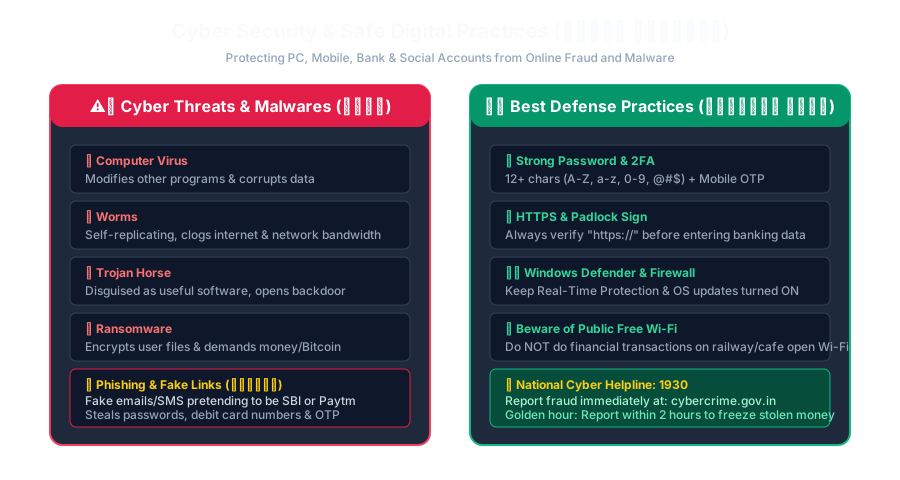
Free Wi-Fi at railway stations, bus stands, hotels, and cafes is open and unencrypted:
- Man-in-the-Middle (MitM) Attacks: Hackers connected to the same free Wi-Fi can intercept unencrypted data packets transmitted between your mobile phone and the router.
- Rogue Hotspots (Evil Twin): Cybercriminals set up fake open Wi-Fi hotspots named "Free_Railway_WiFi" to trick users into connecting, capturing all their traffic.
- Golden Rule: Never conduct banking transactions, UPI payments, or enter confidential passwords while connected to public open Wi-Fi. Always switch to your personal mobile data (4G/5G).
 Click to Zoom
4. Lost or Stolen Phone Protection
If your smartphone is lost or stolen, take immediate action to protect your identity and money:
- 1Find My Device (Android) / Find My (iPhone):
- Allows you to locate your phone on a map, ring it remotely, lock the screen, or perform a Remote Factory Reset (Wipe) to delete all sensitive data.
- 1CEIR Portal (Central Equipment Identity Register - Government of India):
- Visit the official Indian portal ceir.gov.in to block the unique IMEI number of your stolen phone across all telecom networks in India, rendering the stolen handset completely useless even if the thief inserts a new SIM card.
- 1Block SIM Card & UPI Immediately:
- Call your telecom operator (Jio, Airtel, Vi, BSNL) to block your SIM card so thieves cannot receive OTPs.
- Contact your bank to temporarily freeze internet banking and UPI linked to your mobile number.
Multiple Choice Questions
1. Which official Government of India portal allows citizens to track and block lost or stolen mobile phones using their IMEI number?
A. IRCTC Portal B. CEIR (Central Equipment Identity Register - ceir.gov.in) C. UMANG Portal D. Digilocker Portal Answer: B Explanation: CEIR (Central Equipment Identity Register) operated by the Department of Telecommunications allows users to block stolen mobile devices across all Indian networks.
2. Why should a user avoid conducting financial transactions on free public Wi-Fi at railway stations or cafes?
A. Public Wi-Fi consumes phone battery faster B. Unsecured networks allow attackers to intercept sensitive traffic through Man-in-the-Middle (MitM) attacks C. Public Wi-Fi automatically deletes your contact list D. Bank websites are permanently blocked on Wi-Fi Answer: B Explanation: Public open Wi-Fi networks lack encryption, allowing malicious actors on the same network to intercept transmission packets and capture credentials.
3. Which built-in Android service continuously scans apps for malicious behavior and security threats?
A. Google Maps B. Google Play Protect C. Android Auto D. Google Drive Answer: B Explanation: Google Play Protect scans apps before and after download from the Play Store to verify they are free from malware and malicious code.
4. What type of file extension is used to manually install mobile applications on the Android operating system?
A. .exe B. .apk C. .docx D. .mp4 Answer: B Explanation: Android Application Package (.apk) is the file format used by the Android OS for the distribution and installation of mobile apps.
5. Why is it dangerous to grant 'SMS' permission to an unknown third-party game or utility app?
A. The game will play sound effects via SMS B. The app can silently read incoming bank OTPs and authentication codes to commit financial fraud C. The app will change your phone number D. Your phone screen will shut down permanently Answer: B Explanation: SMS permission allows apps to read text messages, including sensitive One-Time Passwords (OTPs) sent by banks for fund transfers.
Recognizing Online Fraud and Phishing
Continue learning with hands-on practice, examples, and exercises in the upcoming topic.
Related Lessons
| Previous Lesson | Next Lesson |
|---|---|
| Social Media Safety and Password Protection | Recognizing Online Fraud and Phishing |
Practice Quiz
Test your understanding of this lesson with 5 questions. Each question has one correct answer.