Unordered Lists & Bullet Customization
Lists are indispensable for organizing information, outlining features, and enumerating project requirements. In Markdown, unordered lists represent bulleted collections where the sequence does not imply a chronological order.
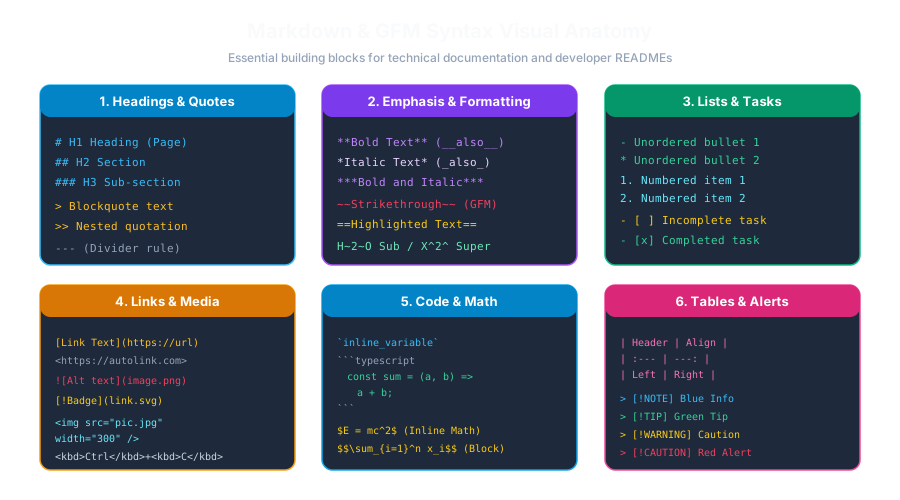 Click to Zoom
1. Unordered List Markers
You can create an unordered bullet item using any of three characters: dash (-), *asterisk (`)**, or **plus (+`)**, followed by a space:
All three symbols compile to the identical HTML <ul><li>...</li></ul> structure.
-) for consistency.2. Nested Unordered Lists
To nest a sub-list inside an existing list item, indent the sub-items by 2 or 4 spaces (or 1 Tab):
3. Tight vs. Loose Lists (Spacing Matters!)
Understanding the difference between tight and loose lists is a mark of an experienced Markdown writer:
Tight List (No paragraph wrapping):
When items have no blank lines between them, the HTML compiles without <p> tags inside the <li>:
HTML: <li>Clean item 1</li>
Loose List (With paragraph wrapping):
If you insert a blank line between any items in the list, the entire list becomes "loose", wrapping each item in <p> tags with extra paragraph margins:
HTML: <li><p>Detailed item 1 with extensive explanation.</p></li>
Multiple Choice Questions
1. Which of the following symbols CANNOT be used to create an unordered list item in standard Markdown?
A. Hyphen (-) B. Asterisk () C. Plus sign (+) D. Dollar sign ($) Answer: D Explanation: Standard Markdown supports -, , and + as unordered bullet markers. The dollar sign ($) is not a list marker.
2. Which HTML element is generated for an unordered list container in Markdown?
A. <ol> B. <ul> C. <dl> D. <menu> Answer: B Explanation: Unordered bullet lists compile to an HTML <ul> (Unordered List) element.
3. How do you nest a sub-bullet list inside an existing list item?
A. Type -> before the word B. Indent the child items by 2 or 4 spaces beneath the parent item C. Use a colon at the end of the line D. Enclose the items in parentheses Answer: B Explanation: Indenting the child line by 2 or 4 spaces nests it as a sub-list item inside the preceding parent item.
4. What distinguishes a 'loose list' from a 'tight list' in Markdown parsing?
A. A loose list has blank lines between items, causing parsers to wrap list items in <p> paragraph tags B. A loose list uses numbers instead of bullets C. A loose list is rendered in italic font D. A loose list deletes the last item Answer: A Explanation: Adding blank lines between list items makes the list loose, instructing the parser to wrap item contents in <p> tags for larger spacing.
5. What is the recommended industry standard symbol for unordered lists across modern repositories?
A. Hyphen (-) B. Plus (+) C. Ampersand (&) D. Tilde (~) Answer: A Explanation: The hyphen (-) is the most commonly recommended marker in documentation style guides for consistency.
Ordered Lists & Nested Outlines
Continue learning with hands-on practice, examples, and exercises in the upcoming topic.
Related Lessons
| Previous Lesson | Next Lesson |
|---|---|
| Blockquotes, Nested Quotes & Callouts | Ordered Lists & Nested Outlines |
Practice Quiz
Test your understanding of this lesson with 5 questions. Each question has one correct answer.