Inline Code & Backtick Escaping Rules
In technical documentation, distinguishing between ordinary human language and technical identifiers (such as function names, shell commands, file paths, and environment variables) is critical. Markdown uses backticks (``) for inline code formatting.
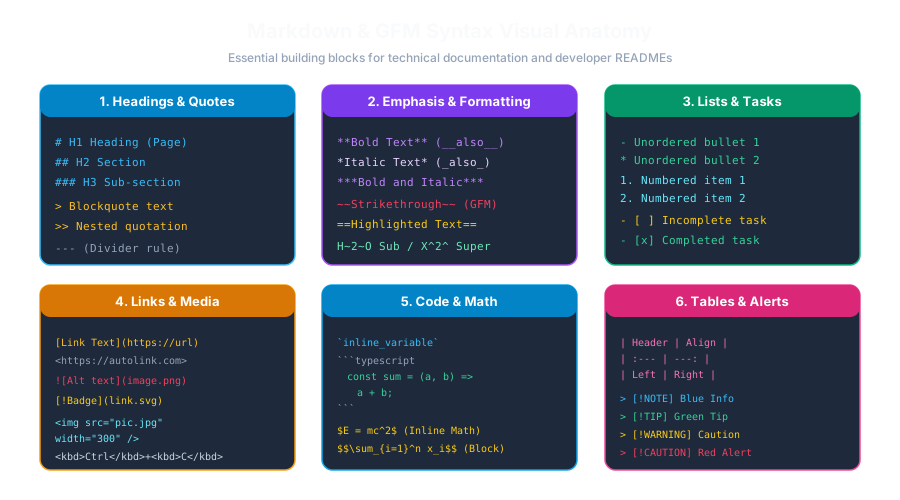 Click to Zoom
1. Basic Inline Code Syntax
To format text as inline code, surround it with a single backtick (``):
- HTML Output:
<code>npm install</code> - Styling: Browsers render
<code>in a monospaced font (like Courier or JetBrains Mono) with a subtle background shade.
2. The Backtick Escaping Dilemma
What happens if the code snippet you want to display contains a backtick itself?
For example, in JavaScript template literals:
If you wrap this in single backticks (` const greeting = Hello ${name}; `), the parser gets confused because it sees the first backtick as the closing delimiter!
3. The Double-Backtick Escaping Rule (CommonMark Standard)
To display a literal backtick inside inline code, wrap the code in double backticks (` ``):
Rendered Output: Use code to format inline code in Markdown.
hello ``
- The parser will automatically strip the outer single padding spaces from the rendered output!4. When to Use Inline Code vs. Fenced Code Blocks
Use Inline Code (` code `) | Use Fenced Code Block (```js) |
|---|---|
Single words, function names: fetch() | Multi-line scripts, complete functions |
CLI commands: git commit -m "feat" | Configuration files (JSON, YAML, Dockerfile) |
File names and paths: package.json | Code that requires syntax highlighting |
Keyboard keys and HTTP status codes: 404 | Terminal output logs with multiple lines |
Multiple Choice Questions
1. Which character is used to format text as inline code in Markdown?
A. Single quote (') B. Backtick () C. Tilde (~) D. Double quote (") **Answer:** B **Explanation:** A pair of backticks (...`) formats text as inline code, mapping to the HTML <code> element.
2. How do you display a literal backtick inside an inline code snippet without breaking the parser?
A. Surround the snippet with double backticks: ` code B. Prepend a dollar sign ($) C. Backticks cannot be displayed in Markdown D. Type 'escape-backtick' Answer: A Explanation: CommonMark allows multi-backtick delimiters (e.g. double backticks ``) to enclose snippets containing single backticks.
3. Which HTML tag is generated by inline Markdown code?
A. <kbd> B. <code> C. <pre> D. <samp> Answer: B Explanation: Single backtick code spans compile to the HTML <code> inline element.
4. What is the primary purpose of inline code formatting in technical documents?
A. To automatically execute the command on the reader's computer B. To render technical identifiers (variables, paths, commands) in a distinct monospaced font C. To change text color to bright red D. To translate English words into binary Answer: B Explanation: Inline code formatting provides semantic clarity, rendering technical syntax in monospaced typography to distinguish it from prose.
5. If your inline code begins with a literal backtick, what spacing rule applies inside double backticks?
A. You must leave one space between the delimiter and the backtick (e.g. ` literal `) B. You must write the word in capital letters C. You must press Enter three times D. No space is permitted Answer: A Explanation: CommonMark specifies that if a code span begins or ends with a space, one leading and trailing space is stripped, allowing backtick borders to be escaped cleanly.
Fenced Code Blocks & Syntax Highlighting
Continue learning with hands-on practice, examples, and exercises in the upcoming topic.
Related Lessons
| Previous Lesson | Next Lesson |
|---|---|
| Embedding Raw HTML & Media in Markdown | Fenced Code Blocks & Syntax Highlighting |
Practice Quiz
Test your understanding of this lesson with 5 questions. Each question has one correct answer.