1D Array Indexing, Slicing & Step Strides
1D Array Indexing, Slicing & Step Strides
Indexing and slicing allow you to extract individual elements, sub-ranges, and strided patterns from arrays. While 1D NumPy slicing closely resembles Python list slicing, it introduces fundamental differences in memory handling and performance.
1. Zero-Based & Negative Indexing
Like standard Python, NumPy uses zero-based indexing for forward navigation and negative integers to count backwards from the end:
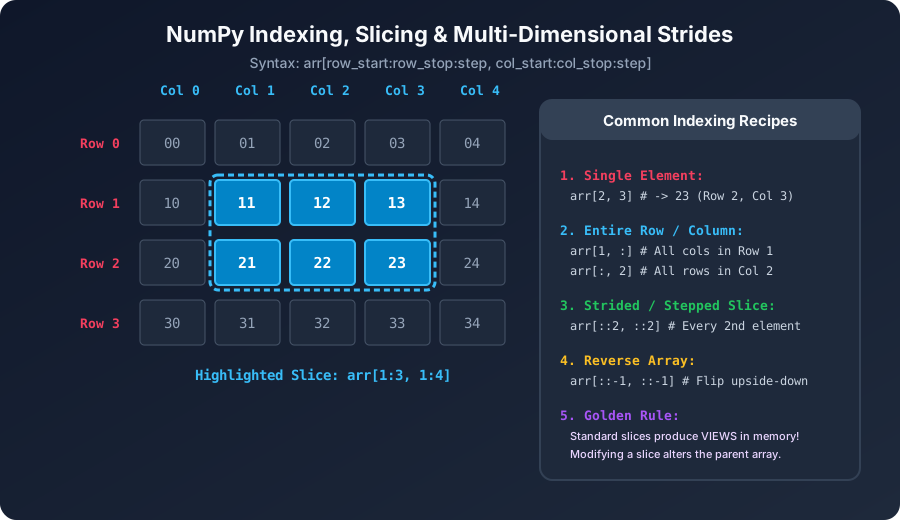 Click to Zoom
2. Basic Slicing Syntax: [start : stop : step]
A slice extracts a range of elements defined by three parameters separated by colons:
3. The Power of In-Place Mutation via Slices
In pure Python lists, assigning to a slice copies new pointers. In NumPy, assigning a scalar to a slice performs an instant vectorized broadcast assignment in contiguous RAM:
Multiple Choice Questions
1. What will 'arr[1:5]' extract from 'arr = np.array([10, 20, 30, 40, 50, 60])'?
A. array([10, 20, 30, 40, 50]) B. array([20, 30, 40, 50]) C. array([20, 30, 40]) D. array([10, 50]) Answer: B Explanation: Index 1 is 20; the slice stops before index 5 (60), returning elements at indices 1, 2, 3, and 4 ([20, 30, 40, 50]).
2. What is the most concise, idiomatic NumPy slice expression to invert the order of an array backwards?
A. arr.reverse() B. arr[::-1] C. arr[-1:0] D. arr[0:-1:-1] Answer: B Explanation: Slicing with [::-1] sets the step stride to -1 from end to start, reversing the array in constant time as a memory view.
3. What happens when you execute 'arr[2:5] = 0' on a NumPy array?
A. Deletes indices 2, 3, and 4 B. Sets elements at indices 2, 3, and 4 to 0 simultaneously via broadcast assignment C. Raises a TypeError D. Converts the array to None Answer: B Explanation: NumPy supports slice assignment; setting a slice equal to a scalar broadcasts that value across all elements in the slice.
4. What will 'np.arange(10)[::3]' return?
A. array([0, 3, 6, 9]) B. array([3, 6, 9]) C. array([0, 1, 2]) D. array([9, 6, 3, 0]) Answer: A Explanation: The slice [::3] steps across the range 0 to 9 with a stride of 3, extracting indices 0, 3, 6, and 9.
5. In the slice syntax 'arr[start:stop:step]', which boundary is EXCLUDED from the returned array?
A. start B. stop C. step D. None, all boundaries are inclusive Answer: B Explanation: Slicing in Python and NumPy follows half-open intervals [start, stop) where the stop index is strictly excluded.
Multi-Dimensional Array Slicing (Row, Column & Matrix Slices)
Continue learning with hands-on practice, examples, and exercises in the upcoming topic.
Related Lessons
Practice Quiz
Test your understanding of this lesson with 5 questions. Each question has one correct answer.