Excel Online, Real-Time Co-Authoring & Version History
Excel Online, Real-Time Co-Authoring & Version History
Gone are the days of emailing spreadsheets titled Budget_v2_Final_FINAL_Approved.xlsx. With Excel for the Web (Excel Online) and Microsoft 365 cloud co-authoring, dozens of users can work inside the exact same spreadsheet simultaneously in real-time, backed by automatic version control.
1. Real-Time Co-Authoring & Presence Indicators
When a workbook is saved in OneDrive or SharePoint, real-time co-authoring activates automatically:
- Colored Presence Rings: Colored avatars appear in the top-right corner showing everyone currently inside the workbook.
- Live Selection Cursors: Colored cell borders float across the worksheet showing which cells other users are actively editing in real-time.
- Conflict Resolution: If two users edit the exact same cell simultaneously, Excel flags the collision and keeps the latest committed change while logging the event.
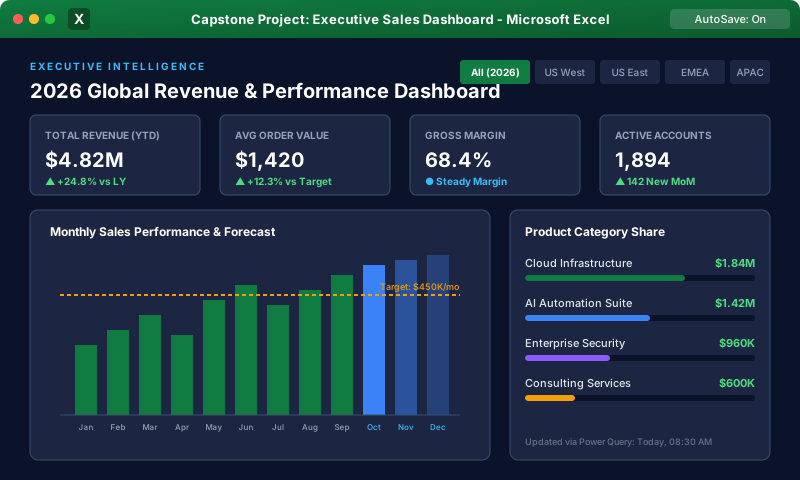 Click to Zoom
2. Sheet View: Filtering Without Annoying Co-Workers!
The biggest issue in shared workbooks used to be filter conflicts: User A filters by "North", which hides rows for User B who was working on "South"! Sheet View solves this permanently:
- 1In Excel Online or 365, go to the View tab.
- 2In the Sheet View group, click New.
- 3The row and column headers turn black, indicating you are in a temporary private view.
- 4Filter, sort, and rearrange data as much as you want—no one else sees your filters!
- 5When finished, click Exit or name and save the view for future personal use.
3. Version History: The Ultimate Safety Net
If an accidental macro or formula wipes out critical financial models, you can restore previous states effortlessly:
- 1Click the workbook title at the top of the window (or go to File > Info > Version History).
- 2The Version History side pane opens showing timestamps and author names for every autosave over days, weeks, or months.
- 3Click any previous version to view a complete read-only preview.
- 4Click Restore to roll the entire workbook back to that exact state, or save a copy without disturbing the current file!
Multiple Choice Questions
1. What feature allows an analyst to filter and sort a shared cloud workbook without disrupting the view for other active co-authors?
A. Freeze Panes B. Sheet View (View > New Sheet View) C. Print Preview D. Split Screen Answer: B Explanation: Sheet View provides a private viewing mode where a user can sort and filter data independently without altering what other collaborators see.
2. How can you recover an earlier version of an Excel workbook if someone accidentally scrambled the data?
A. Press Ctrl + Z 10,000 times B. File > Info > Version History (select previous timestamp and click Restore) C. Format the computer hard drive D. Re-type the entire model Answer: B Explanation: Version History logs automatic cloud snapshots, allowing users to inspect and restore previous file states.
3. What visual indicator reveals where another person is currently working in a co-authored Excel workbook?
A. The entire sheet flashes red B. A colored selection border with their name tag appears around the cell they are editing C. A pop-up message appears every 5 seconds D. The mouse arrow moves automatically Answer: B Explanation: Real-time presence indicators display distinct colored bounding boxes and name labels over the cells actively selected by collaborators.
4. Where must an Excel workbook be stored to enable real-time cloud co-authoring?
A. On a local USB flash drive B. In Microsoft OneDrive or SharePoint C. On a CD-ROM D. Inside a .ZIP archive Answer: B Explanation: Real-time co-authoring relies on Microsoft 365 cloud synchronization infrastructure provided by OneDrive and SharePoint.
5. What color do worksheet row and column headers turn when an analyst is working inside a temporary private 'Sheet View'?
A. Bright yellow B. Black C. Neon green D. Red Answer: B Explanation: Black row and column headers visually indicate that an isolated, private Sheet View is currently active.
Capstone: Building the Business Performance Data Model
Continue learning with hands-on practice, examples, and exercises in the upcoming topic.
Related Lessons
| Previous Lesson | Next Lesson |
|---|---|
| Sharing, Threaded Comments and Tracking Changes | Capstone: Building the Business Performance Data Model |
Practice Quiz
Test your understanding of this lesson with 5 questions. Each question has one correct answer.