Dot Products & Matrix Multiplication (dot, @ operator, matmul)
Vector & Matrix Multiplication: dot(), matmul(), and @
In linear algebra, machine learning (neural networks, linear regression), and 3D computer graphics, matrix multiplication is the foundational building block.
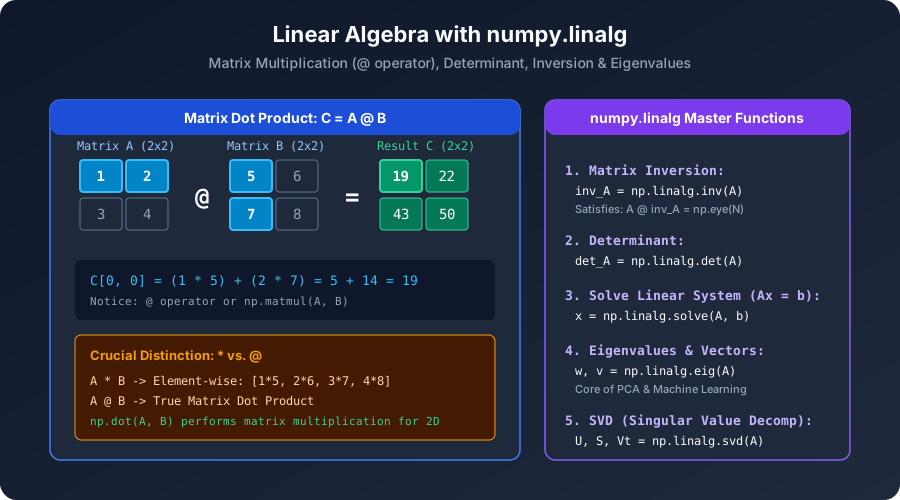
One of the most frequent points of confusion for newcomers to NumPy is distinguishing between element-wise multiplication (*) and formal linear algebraic matrix multiplication (@ or matmul()).
 Click to Zoom
1. Element-wise vs Matrix Multiplication
- *Element-wise Product (``):** Multiplies elements at matching positions. Arrays must have compatible shapes for broadcasting.
- Matrix Multiplication (
@ornp.matmul): Computes row-by-column inner dot products according to formal linear algebra rules:
$$C_{ij} = \sum_{k=1}^K A_{ik} B_{kj}$$
For matrices $A$ of shape $(M, K)$ and $B$ of shape $(K, N)$, the inner dimensions ($K$) must match exactly, and the resulting matrix $C$ has shape $(M, N)$.
2. The Difference Between np.dot() and np.matmul()
NumPy provides both np.dot() and np.matmul() (or the @ operator). For 2D matrices, they produce identical results. However, their behaviors diverge on 1D vectors and higher-order tensors:
A. 1D Vector Dot Product (Inner Product)
For 1D vectors, both compute the standard scalar inner product:
B. Higher-Order Tensors and Batch Matrix Multiplication
This is where matmul() / @ shines and is the standard for deep learning:
np.matmul()treats trailing 2 dimensions as matrices and broadcasts over leading batch dimensions.np.dot()computes a sum-product over the last axis of $A$ and second-to-last axis of $B$, which is not batch matrix multiplication!
3. Vector-Matrix Multiplication
When multiplying a 1D vector $v$ with a 2D matrix $M$:
- If $v$ is on the left (
v @ M), NumPy temporarily promotes $v$ to a row matrix $(1, K)$, performs multiplication, and squeezes the output back to a 1D vector. - If $v$ is on the right (
M @ v), NumPy promotes $v$ to a column matrix $(K, 1)$, performs multiplication, and squeezes back:
Multiple Choice Questions
1. Which Python operator is designated for matrix multiplication?
A. * B. ** C. @ D. ^ Answer: C Explanation: Introduced in Python 3.5 (PEP 465), the @ operator designates matrix multiplication and invokes __matmul__ on NumPy ndarrays.
2. If matrix $A$ has shape $(4, 7)$ and matrix $B$ has shape $(7, 3)$, what is the shape of $A @ B$?
A. (4, 7) B. (7, 7) C. (4, 3) D. (3, 4) Answer: C Explanation: The inner dimensions (7) match and cancel out, yielding a resulting matrix with dimensions of the outer shapes: $(4, 3)$.
3. What is the fundamental difference between np.matmul and np.dot on 3D tensors?
A. np.matmul only works on floats B. np.matmul performs batch matrix multiplication by broadcasting over leading dimensions, whereas np.dot computes tensor contraction C. np.dot is faster on GPUs D. np.matmul does not support 2D arrays Answer: B Explanation: np.matmul treats multi-dimensional arrays as batches of 2D matrices, broadcasting across batch dimensions—crucial for deep learning architectures.
4. Given a = np.array([1, 2]) and b = np.array([3, 4]), what is a * b?
A. array([3, 8]) B. 11 C. array([[3, 4], [6, 8]]) D. array([4, 6]) Answer: A Explanation: The * operator performs element-wise multiplication: [1*3, 2*4] = [3, 8]. (The matrix/dot product would be $1 imes3 + 2 imes4 = 11$).
5. Why does multiplying a matrix of shape (3, 5) with a matrix of shape (3, 5) using A @ B raise a ValueError?
A. Matrices must be square B. The inner dimensions (5 and 3) do not match C. The dtype is incompatible D. The arrays must be transposed first Answer: B Explanation: In matrix multiplication $(M, K) imes (P, N)$, $K$ must equal $P$. Here $K=5$ and $P=3$, which are incompatible.
Matrix Determinant, Inversion & Solving Linear Systems
Continue learning with hands-on practice, examples, and exercises in the upcoming topic.
Related Lessons
Practice Quiz
Test your understanding of this lesson with 5 questions. Each question has one correct answer.