Built-in Creation Routines (zeros, ones, full, empty)
Built-in Creation Routines (zeros, ones, full, empty)
Converting Python lists is convenient for small tests, but in production machine learning and scientific simulations, allocating arrays containing millions of pre-initialized cells must be done without allocating Python objects first. NumPy provides specialized built-in memory allocation routines.
1. Allocating Zeros with np.zeros()
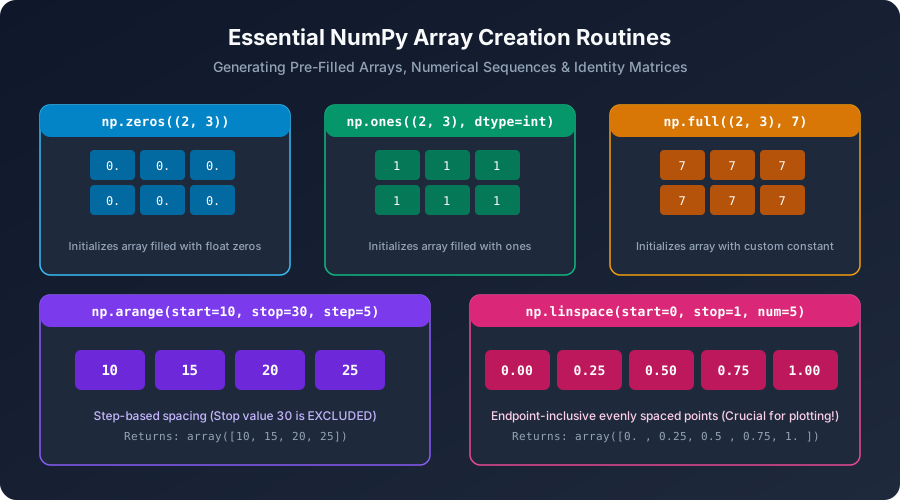
np.zeros() allocates a contiguous block of memory and fills every byte with 0:
Common Use Case: Initializing weight matrices, zero-padding convolution masks, or accumulator buffers in numerical simulations.
 Click to Zoom
2. Allocating Ones with np.ones()
np.ones() operates identically to zeros(), but initializes every element to 1:
Common Use Case: Baseline probability priors, bias vectors in neural networks, and multiplier masks.
3. Allocating Constant Values with np.full()
When you need an array initialized with any arbitrary constant value (e.g., 7, -1, 3.14, or np.nan):
4. High-Speed Allocation with np.empty()
What if you are about to overwrite every single element of an array immediately with data from a disk stream or sensor? Initializing cells to 0 wastes CPU write cycles. np.empty() allocates memory without initializing its values:
np.empty() does not clear memory! The array will contain unpredictable residual bits (garbage values) left behind by other applications. Never read from an empty() array before writing to it!5. The Like-Family: Matching Existing Arrays
NumPy provides companion routines that mirror the shape and dtype of an existing template array:
Multiple Choice Questions
1. What is the default data type (dtype) created by 'np.zeros(5)' if no explicit dtype is provided?
A. int32 B. float64 C. bool D. string Answer: B Explanation: NumPy array creation routines like np.zeros() and np.ones() default to 64-bit floating point (float64) numbers.
2. What does 'np.empty((3, 3))' return?
A. An array with 0 rows and 0 columns B. An array allocated in memory containing arbitrary uninitialized residual garbage values C. An array of empty strings D. A Python NoneType Answer: B Explanation: np.empty() allocates the memory buffer without spending CPU time zeroing the bits, leaving whatever residual data was previously in that RAM space.
3. Which function creates a (4, 4) matrix where every element is initialized to the number -1?
A. np.minus_ones((4, 4)) B. np.full((4, 4), -1) C. np.fill((4, 4), -1) D. np.constant((4, 4), -1) Answer: B Explanation: np.full(shape, fill_value) initializes an array of the specified dimensions populated with the given constant value.
4. How can you quickly create an array of ones that has the exact same shape and data type as an existing array named 'features'?
A. np.ones(features.shape, dtype=features.dtype) B. np.ones_like(features) C. Both A and B are valid, with B being the most idiomatic D. features.to_ones() Answer: C Explanation: While np.ones(features.shape, dtype=features.dtype) works, np.ones_like(features) is the idiomatic, built-in shorthand.
5. Why should 'np.zeros()' be passed a tuple for multidimensional shapes (e.g., 'np.zeros((3, 4))') rather than two separate arguments?
A. The first argument is the shape tuple; passing 'np.zeros(3, 4)' causes 4 to be interpreted as the dtype parameter B. Separate arguments are deprecated in Python 3 C. Tuples calculate faster than numbers D. Separate numbers cause an operating system crash Answer: A Explanation: In np.zeros(shape, dtype=float, ...), the shape argument must be a sequence (like a tuple (3, 4)); passing separate numbers passes 4 to the dtype argument, causing a TypeError.
Generating Numerical Sequences (arange, linspace, logspace)
Continue learning with hands-on practice, examples, and exercises in the upcoming topic.
Related Lessons
Practice Quiz
Test your understanding of this lesson with 5 questions. Each question has one correct answer.