Dynamic Programming: Overlapping Subproblems, Memoization vs Tabulation
Dynamic Programming: Overlapping Subproblems, Memoization vs Tabulation
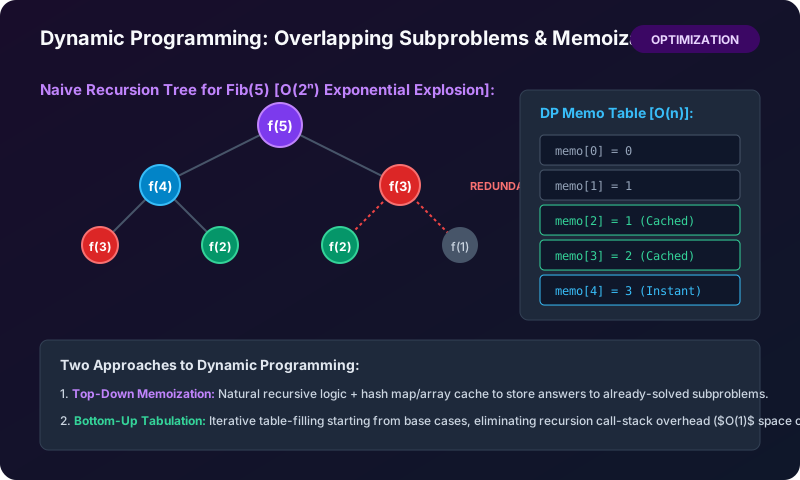
Dynamic Programming (DP) is a powerful algorithmic paradigm used to solve complex optimization problems by breaking them down into simpler, overlapping subproblems. Rather than recomputing solutions to identical subproblems repeatedly, DP computes each subproblem solution exactly once and stores the result in memory (caching).
 Click to Zoom
1. The Two Core Prerequisites of DP
A problem can be solved with Dynamic Programming if and only if it exhibits both of the following mathematical properties:
- 1Optimal Substructure:
- An optimal solution to the overall problem contains within it optimal solutions to its subproblems.
- Example: The shortest path from $A$ to $C$ via $B$ consists of the shortest path from $A$ to $B$ plus the shortest path from $B$ to $C$.
- 1Overlapping Subproblems:
- The recursive decomposition visits the same identical subproblem states repeatedly.
- Example: In naive Fibonacci calculation:
$$\text{Fib}(5) = \text{Fib}(4) + \text{Fib}(3)$$ $$\text{Fib}(4) = \text{Fib}(3) + \text{Fib}(2)$$ Notice that $\text{Fib}(3)$ is computed twice, $\text{Fib}(2)$ three times, leading to explosive $O(2^n)$ exponential duplication!
2. Top-Down Memoization vs. Bottom-Up Tabulation
Direct Comparison
| Feature | Top-Down (Memoization) | Bottom-Up (Tabulation) |
|---|---|---|
| Flow of Execution | Root to Leaves (Target down to Base Cases) | Leaves to Root (Base Cases up to Target) |
| Implementation | Recursion + Cache (Hash Map or Array) | Iterative for loops + Array table |
| Subproblem Coverage | Computes only reachable subproblems | Computes all table states in sequence |
| Space Optimization | Difficult to reduce space complexity | Often reducible from $O(n)$ to $O(1)$ space |
| Stack Overflow Risk | Yes, if recursion depth exceeds system limit | Zero risk; pure iterative execution |
3. The 5-Step Framework to Master Any DP Problem
When faced with any DP question in an interview, follow this structured blueprint:
- 1Define the State: What does
dp[i](ordp[i][j]) represent in plain English? - 2Formulate the Recurrence Relation (Transition): How does
dp[i]depend on previous states (e.g.,dp[i-1],dp[i-2])? - 3Identify the Base Cases: What are the trivial stopping conditions that cannot be broken down further (e.g.,
dp[0] = 0,dp[1] = 1)? - 4Determine the Order of Computation: In what order must the table be filled so that dependencies are already resolved when calculating the current state?
- 5Space Optimization (Optional): Can we replace the full $O(n)$ array with just 2 or 3 scalar variables?
4. Case Study: Climbing Stairs (LeetCode 70)
Problem: You are climbing a staircase with $n$ steps. Each time you can climb either 1 or 2 steps. In how many distinct ways can you climb to the top?
Step 1: State Definition
Let dp[i] be the number of distinct ways to reach step i.
Step 2: Recurrence Relation
To reach step i, you could have jumped from step i-1 (by taking 1 step) or from step i-2 (by taking 2 steps): $$\text{dp}[i] = \text{dp}[i-1] + \text{dp}[i-2]$$
Step 3: Base Cases
dp[1] = 1(Only 1 way:[1])dp[2] = 2(2 ways:[1, 1]or[2])
Step-by-Step Trace Table for $n = 5$
| Step ($i$) | Ways from $i-1$ | Ways from $i-2$ | Total Ways dp[i] | Possible Paths |
|---|---|---|---|---|
| 1 | - | - | 1 | (1) |
| 2 | - | - | 2 | (1+1), (2) |
| 3 | dp[2] = 2 | dp[1] = 1 | 3 | (1+1+1), (2+1), (1+2) |
| 4 | dp[3] = 3 | dp[2] = 2 | 5 | All 3 from step 3 + all 2 from step 2 |
| 5 | dp[4] = 5 | dp[3] = 3 | 8 | $5 + 3 = 8$ distinct paths |
5. Dual-Language Implementation
Python 3: All Approaches
Modern JavaScript (Node.js) Implementation
6. Complexity Comparison
| Implementation | Time Complexity | Auxiliary Space Complexity | Call Stack Overhead |
|---|---|---|---|
| Naive Recursion | $O(2^n)$ (Exponential!) | $O(n)$ | Yes |
| Top-Down Memoization | $O(n)$ (Linear) | $O(n)$ (Memo table + Call stack) | Yes |
| Bottom-Up Tabulation | $O(n)$ (Linear) | $O(n)$ (DP array) | No |
| Space-Optimized DP | $O(n)$ (Linear) | $O(1)$ (Only two variables) | No |
Multiple Choice Questions
Classic DP Master Patterns: 0/1 Knapsack, Coin Change & LCS
Continue learning with hands-on practice, examples, and exercises in the upcoming topic.
Related Lessons
Practice Quiz
Test your understanding of this lesson with 5 questions. Each question has one correct answer.