Introduction to DSA, Big-O, Big-Omega & Big-Theta Notations
Introduction to DSA, Big-O, Big-Omega & Big-Theta Notations
Data Structures and Algorithms (DSA) represent the foundational engineering science of software development. A Data Structure is a specialized format for organizing, storing, and retrieving data in computer memory, while an Algorithm is an unambiguous step-by-step computational procedure that transforms input into desired output.
1. Real-World Analogy: The City Library Index
Imagine a city library with 500,000 books dumped into a single giant pile on the floor. Finding "Harry Potter" would require inspecting every single book one by one from top to bottom. If examining each book takes 1 second, it could take up to 5.7 days to find a book!
Now imagine the books are organized on alphabetized bookshelves with a Dewey Decimal index catalog. You walk straight to Section H, Row 4, and retrieve the book in under 20 seconds.
- The Bookshelf & Catalog system is the Data Structure.
- The Binary Search lookup technique you used to reach the
Hshelf is the Algorithm.
2. Asymptotic Notations: Measuring Efficiency
Computers vary wildly in hardware specifications. An algorithm running on a 64-core supercomputer will execute faster in clock time than on a 10-year-old smartphone. Therefore, computer scientists do not measure algorithm efficiency in seconds; instead, we analyze how the number of computational operations grows as the input size ($n$) scales towards infinity.
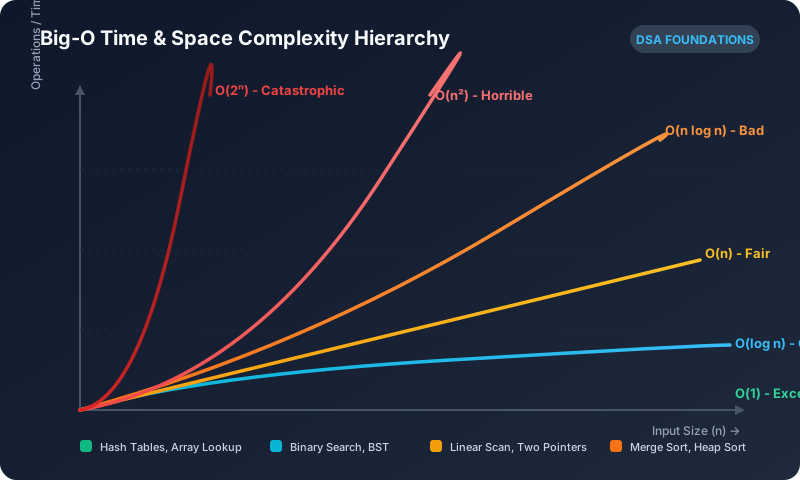 Click to Zoom
The Three Pillars of Asymptotic Notation
- 1Big-O ($O$) — Worst-Case Upper Bound: Represents the absolute maximum number of operations an algorithm will ever take. In technical interviews and production SLAs, Big-O is what engineers care about most because it guarantees performance limits.
- 2Big-$\Omega$ ($\Omega$) — Best-Case Lower Bound: The minimum number of steps required under optimal input conditions (e.g., finding the target at index 0 of an array on the first guess).
- 3Big-$\Theta$ ($\Theta$) — Tight Bound: Occurs when the best-case and worst-case growth rates match asymptotically.
3. Common Time Complexity Classes
| Big-O Class | Name | Operations for $n = 10^6$ | Typical Examples |
|---|---|---|---|
| $O(1)$ | Constant Time | $\approx 1$ step | Array index lookup, Hash Map get/put, Stack push |
| $O(\log n)$ | Logarithmic Time | $\approx 20$ steps | Binary Search, Balanced BST search |
| $O(n)$ | Linear Time | $\approx 10^6$ steps | Linear scan, finding array maximum, Two-pointer pass |
| $O(n \log n)$ | Linearithmic | $\approx 2 \times 10^7$ steps | Merge Sort, Quick Sort (average), Heap Sort |
| $O(n^2)$ | Quadratic Time | $\approx 10^{12}$ steps | Nested loops, Bubble Sort, pairwise combinations |
| $O(2^n)$ | Exponential Time | $> 10^{300,000}$ steps | Recursive Fibonacci, generating all power sets |
4. Code Comparison: $O(1)$ vs $O(n)$ vs $O(n^2)$
Python 3 Implementation:
Modern JavaScript / TypeScript Implementation:
5. Step-by-Step Dry Run: Input Scaling Test
| Input Size ($n$) | $O(1)$ Steps | $O(\log_2 n)$ Steps | $O(n)$ Steps | $O(n^2)$ Steps |
|---|---|---|---|---|
| 10 | 1 | 3.3 | 10 | 100 |
| 100 | 1 | 6.6 | 100 | 10,000 |
| 1,000 | 1 | 10 | 1,000 | 1,000,000 |
| 1,000,000 | 1 | 20 | 1,000,000 | $10^{12}$ (Crash/Timeout) |
Multiple Choice Questions
arr[42])?Time Complexity Calculation Rules & Common Runtime Patterns
Continue learning with hands-on practice, examples, and exercises in the upcoming topic.
Related Lessons
| Previous Lesson | Next Lesson |
|---|---|
| None | Time Complexity Calculation Rules & Common Runtime Patterns |
Practice Quiz
Test your understanding of this lesson with 5 questions. Each question has one correct answer.