Binary Tree Traversals: DFS (Pre, In, Post) & BFS Level-Order0%
Binary Tree Traversals: DFS (Pre, In, Post) & BFS Level-Order
Beginner12 min read•Updated: Jul 11, 2026
Binary Tree Traversals: DFS (Pre, In, Post) & BFS Level-Order
A Binary Tree is a non-linear hierarchical data structure in which each node has at most two children, referred to as the left child and the right child. Binary trees are the building blocks of Binary Search Trees (BST), Heaps, Expression Parsers, and Huffman Coding.
1. Real-World Analogy: Family Genealogy & File Directories
Think of a computer file system directory tree:
- Root folder (
/) contains subfolders (/home,/etc). - Each subfolder contains child files and directories.
- To scan every file on your computer, you can either:
- 1Explore deeply down one folder branch until the bottom before backtracking (Depth-First Search - DFS).
- 2Inspect all immediate files in the current folder, then all files 1 level down, then 2 levels down (Breadth-First Search - BFS).
2. Binary Tree Architectural Diagram
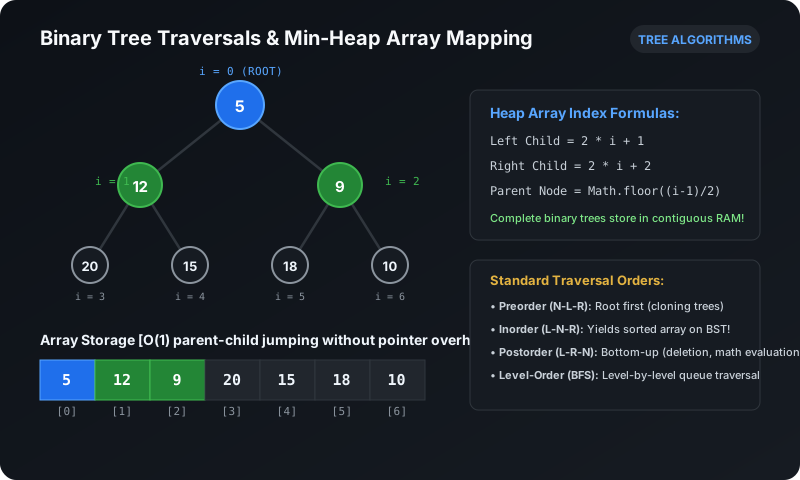 Click to Zoom
3. The 4 Essential Tree Traversals
Depth-First Search (DFS) Variants:
- 1Preorder (Root $\to$ Left $\to$ Right): Useful for cloning/serializing trees.
- 2Inorder (Left $\to$ Root $\to$ Right): In a BST, produces sorted numerical order!
- 3Postorder (Left $\to$ Right $\to$ Root): Bottom-up evaluation (deleting trees, calculating folder sizes).
Breadth-First Search (BFS):
- 1Level-Order: Traverses tree level-by-level from top to bottom using a FIFO Queue.
Output
1
/ \
2 3
/ \
4 5
Preorder: 1 -> 2 -> 4 -> 5 -> 3
Inorder: 4 -> 2 -> 5 -> 1 -> 3
Postorder: 4 -> 5 -> 2 -> 3 -> 1
Level-Order:1 -> 2 -> 3 -> 4 -> 5
4. Multi-Language Implementations
Python 3:
Python
from collections import deque
class TreeNode:
def __init__(self, val: int = 0, left=None, right=None):
self.val = val
self.left = left
self.right = right
# 1. Inorder Traversal (DFS)
def inorder_traversal(root: TreeNode) -> list[int]:
result = []
def dfs(node):
if not node:
return
dfs(node.left) # 1. Traverse Left
result.append(node.val) # 2. Visit Root
dfs(node.right) # 3. Traverse Right
dfs(root)
return result
# 2. Level-Order Traversal (BFS)
def level_order(root: TreeNode) -> list[list[int]]:
if not root:
return []
levels = []
queue = deque([root])
while queue:
level_size = len(queue)
current_level = []
for _ in range(level_size):
node = queue.popleft()
current_level.append(node.val)
if node.left:
queue.append(node.left)
if node.right:
queue.append(node.right)
levels.append(current_level)
return levels
Modern JavaScript / TypeScript:
TypeScript
export class TreeNode {
val: number;
left: TreeNode | null = null;
right: TreeNode | null = null;
constructor(val: number) {
this.val = val;
}
}
// Inorder Traversal
export function inorderTraversal(root: TreeNode | null): number[] {
const result: number[] = [];
function dfs(node: TreeNode | null): void {
if (!node) return;
dfs(node.left);
result.push(node.val);
dfs(node.right);
}
dfs(root);
return result;
}
// Level-Order Traversal (BFS)
export function levelOrder(root: TreeNode | null): number[][] {
if (!root) return [];
const levels: number[][] = [];
const queue: TreeNode[] = [root];
while (queue.length > 0) {
const levelSize = queue.length;
const currentLevel: number[] = [];
for (let i = 0; i < levelSize; i++) {
const node = queue.shift()!;
currentLevel.push(node.val);
if (node.left) queue.push(node.left);
if (node.right) queue.push(node.right);
}
levels.push(currentLevel);
}
return levels;
}
5. Trace Table: Level-Order BFS on Example Tree
| Iteration | Active Queue at Start | levelSize | Dequeued Nodes & Added to Level | Queue After Adding Children |
|---|---|---|---|---|
| Level 0 | [1] | 1 | Dequeue 1 $\to$ Level: [1] | [2, 3] |
| Level 1 | [2, 3] | 2 | Dequeue 2 (add 4,5), Dequeue 3 | [4, 5] |
| Level 2 | [4, 5] | 2 | Dequeue 4, Dequeue 5 | [] (Empty $\to$ Done!) |
Interactive Quiz
Multiple Choice Questions
Question 1
In which order does an "Inorder Traversal" visit the components of a subtree?
Question 2
What data structure is fundamentally required to implement Level-Order (BFS) tree traversal?
Question 3
What is the maximum number of nodes at level $L$ of a binary tree (where root is level 0)?
Question 4
In a Binary Search Tree (BST), which traversal produces the node values in strictly ascending sorted order?
Question 5
What is the time complexity of traversing all $n$ nodes of a binary tree using DFS or BFS?
Next Lesson
Binary Search Trees (BST): Insertion, Deletion, Validation & Inorder Sorting
Continue learning with hands-on practice, examples, and exercises in the upcoming topic.
Related Lessons
Practice Quiz
Test your understanding of this lesson with 5 questions. Each question has one correct answer.