Next.js 15 Overview & App Router vs Pages Router Architecture
Next.js 15 Overview & App Router vs Pages Router Architecture
Next.js is the leading React framework for the web, maintained by Vercel. With Next.js 15, the framework establishes the modern era of full-stack web engineering by building natively on React Server Components (RSC), streaming HTML rendering, and the revolutionary App Router directory architecture.
1. What is Next.js?
While vanilla React is a client-side rendering (CSR) library that ships an empty HTML div id="root" and executes JavaScript in the user's browser, Next.js executes components on the server first. This delivers:
- Instant First Contentful Paint (FCP): Pre-rendered HTML is delivered immediately over the network.
- Flawless SEO: Search engine crawlers (Googlebot, Bing) index real HTML content rather than blank pages.
- Zero-Bundle-Size Server Components: Heavy npm libraries (date-fns, markdown parsers, syntax highlighters) stay on the server and are never downloaded by the client browser.
2. Visual Architecture
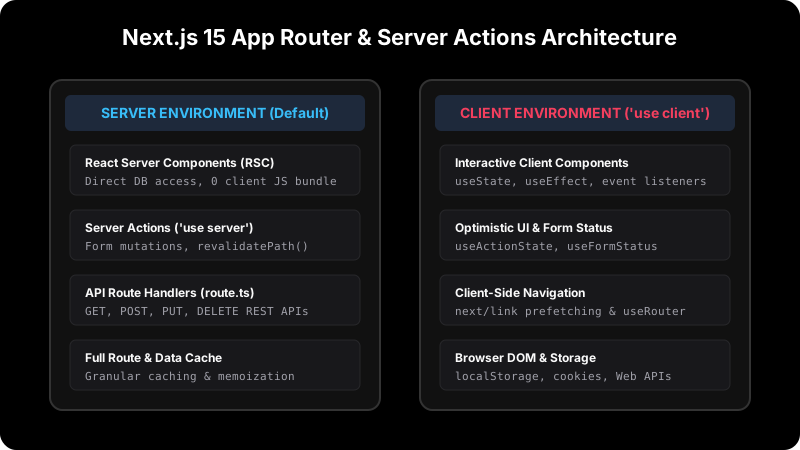 Click to Zoom
3. App Router (app/) vs Legacy Pages Router (pages/)
| Feature | Legacy Pages Router (pages/) | Modern App Router (app/) |
|---|---|---|
| Component Default | Client Components (rendered on client after hydration) | React Server Components (RSC) by default |
| Routing Model | File-path based (pages/about.js) | Folder-hierarchy based (app/about/page.tsx) |
| Layouts | Cumbersome getLayout patterns | Native, nested, persistent layout.tsx hierarchy |
| Data Fetching | getServerSideProps, getStaticProps | Async Server Components with native fetch() & Server Actions |
| Streaming UI | Not supported out of the box | Built-in via React Suspense & loading.tsx |
| Bundle Size | Larger client bundles | Drastically smaller client bundles due to RSC |
4. Why App Router is the Future of React
The App Router aligns directly with React core team's vision:
- 1Colocation of Concerns: Styles, tests, utility components, and data fetching live together inside the feature folder.
- 2Streaming and Concurrency: Slow backend queries stream data chunks to the client progressively without holding up the entire page render.
- 3Seamless Full-Stack Workflows: Server Actions allow mutating database records directly from form elements without creating manual REST endpoints.
Multiple Choice Questions
app/ directory)?app/courses/) to make that route publicly accessible via URL?Core File Conventions: page.tsx, layout.tsx, template.tsx & not-found.tsx
Continue learning with hands-on practice, examples, and exercises in the upcoming topic.
Related Lessons
| Previous Lesson | Next Lesson |
|---|---|
| None | Core File Conventions: page.tsx, layout.tsx, template.tsx & not-found.tsx |
Practice Quiz
Test your understanding of this lesson with 5 questions. Each question has one correct answer.