Document Databases vs Relational SQL: CAP Theorem & When to Use NoSQL
Document Databases vs Relational SQL: CAP Theorem & When to Use NoSQL
Modern web applications demand databases capable of handling massive write loads, dynamic schema evolution, and horizontal distributed scaling. MongoDB is the leading general-purpose, document-oriented NoSQL database designed for high performance, high availability, and effortless scaling.
1. Relational SQL vs Document NoSQL
Traditional relational databases (PostgreSQL, MySQL, Oracle) organize information into rigid two-dimensional tables consisting of rows and columns, enforcing strict schemas and foreign key relationships.
MongoDB, by contrast, stores data in flexible, semi-structured documents grouped into collections:
| Feature | Relational SQL (e.g., PostgreSQL) | Document NoSQL (MongoDB) |
|---|---|---|
| Data Unit | Row / Record | Document |
| Data Container | Table | Collection |
| Schema | Rigid, predefined column DDL | Dynamic, flexible schema per document |
| Relationships | Foreign keys & multi-table JOINs | Embedded subdocuments or references |
| Scaling | Vertical (scale up with bigger CPU/RAM) | Horizontal (scale out across clusters via Sharding) |
| Transactions | ACID transactions by default | Multi-document ACID transactions supported |
2. Visual Architecture
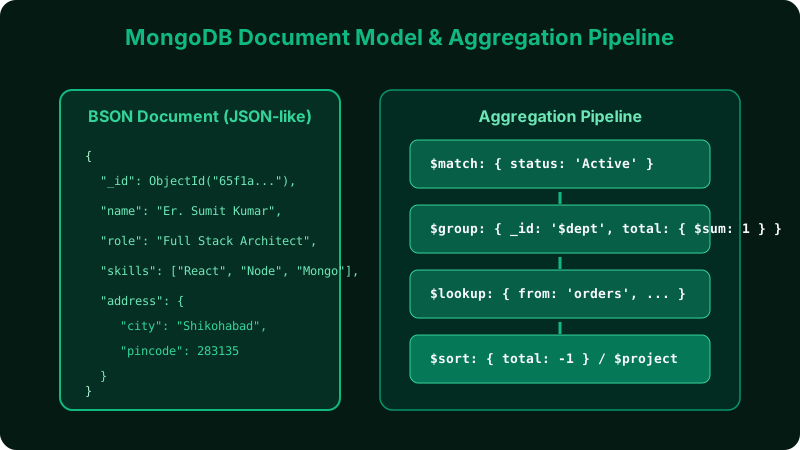 Click to Zoom
3. The CAP Theorem & MongoDB
The CAP Theorem states that a distributed data system can simultaneously guarantee only two out of the following three properties:
- 1Consistency (C): Every read receives the most recent write or an error.
- 2Availability (A): Every non-failing node returns a non-error response for every request.
- 3Partition Tolerance (P): The system continues to operate despite arbitrary network dropouts or node splits.
MongoDB is primarily a CP (Consistent and Partition-Tolerant) system:
- In a standard MongoDB Replica Set with one Primary node and multiple Secondaries, write operations are directed to the Primary.
- If a network partition occurs, MongoDB prioritizes data consistency. If the Primary loses communication with a majority of nodes, it steps down to prevent "split-brain" data corruption.
4. When Should You Choose MongoDB?
- 1Rapidly Evolving Schemas: Startups, agile MVPs, and content management systems where product requirements and data attributes change weekly.
- 2Hierarchical / Nested Data: E-commerce catalogs where a product has variable attributes (e.g. clothing with sizes/colors, laptops with RAM/GPU specs).
- 3High Write Throughput & Big Data: Real-time analytics, IoT sensor telemetry, event logging, and chat logs.
- 4Natural Polymorphism: Collections where different documents share common fields but have distinct specialized payloads.
Multiple Choice Questions
JSON vs BSON Data Types & MongoDB Internal Storage Engine (WiredTiger)
Continue learning with hands-on practice, examples, and exercises in the upcoming topic.
Related Lessons
| Previous Lesson | Next Lesson |
|---|---|
| None | JSON vs BSON Data Types & MongoDB Internal Storage Engine (WiredTiger) |
Practice Quiz
Test your understanding of this lesson with 5 questions. Each question has one correct answer.