Normal Distribution, Z-Scores & Central Limit Theorem0%
Normal Distribution, Z-Scores & Central Limit Theorem
Beginner12 min read•Updated: Jul 11, 2026
Normal Distribution, Z-Scores & Central Limit Theorem
Reading Time: 8 Mins | Level: Intermediate
 Click to Zoom
1. The Normal (Gaussian) Distribution
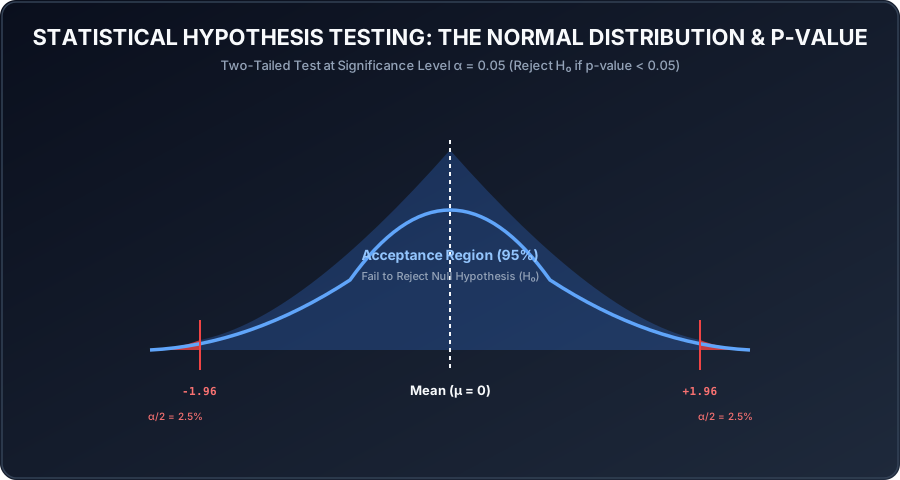
The Normal Distribution is the bell-shaped probability distribution foundational to all inferential statistics. It is governed by two parameters: the Mean ($\mu$) and the Standard Deviation ($\sigma$).
The 68-95-99.7 Empirical Rule:
- $68.27\%$ of data falls within $\mu \pm 1\sigma$.
- $95.45\%$ of data falls within $\mu \pm 2\sigma$ (precisely $\pm 1.96\sigma$ for 95.0%).
- $99.73\%$ of data falls within $\mu \pm 3\sigma$.
2. The Central Limit Theorem (CLT)
The Central Limit Theorem is arguably the most powerful concept in statistics:
Regardless of the underlying population distribution (whether skewed, uniform, bimodal, or exponential), the sampling distribution of the sample mean ($\bar{x}$) approaches a normal distribution as the sample size $n$ increases (typically $n \ge 30$).
Standard Error of the Mean:
$$SE = \frac{\sigma}{\sqrt{n}}$$
As your sample size $n$ increases, your uncertainty ($SE$) shrinks by the square root of $n$.
Interactive Quiz
Multiple Choice Questions
Question 1
According to the Empirical Rule of a Normal Distribution, approximately what percentage of observations fall within $\pm 2$ standard deviations of the mean?
Question 2
What does the Central Limit Theorem (CLT) state about the distribution of sample means?
Question 3
What is the Standard Error (SE) of the sample mean?
Question 4
What happens to the Standard Error as sample size $n$ increases from 100 to 400?
Question 5
In a Standard Normal Distribution, what are the values of the mean and standard deviation?
Next Lesson
Formulating Null & Alternative Hypotheses & p-values
Continue learning with hands-on practice, examples, and exercises in the upcoming topic.
Related Lessons
Practice Quiz
Test your understanding of this lesson with 5 questions. Each question has one correct answer.